
I spent most of Memorial Day weekend at Kublacon, one of the Bay Area’s biggest gaming conventions. I like going to game conventions because, if I plan things right, I’ll get to try a bunch of games that I’d otherwise never play, and tell stories that I’d otherwise never tell. Unfortunately, I didn’t initially think that this year’s Kublacon was going to fall into that category: Because I’d missed the game signup opening time, all of the weird indie games that I’d wanted to try were full and I was stuck in a bunch of 5e games. (Nothing against 5e, I just get to play it here at home fairly often. Again, I crave variety!)
But Kublacon holds a few game slots right until the last minute; and by sitting by my computer and patiently refreshing my browser page for 15 short minutes, I was able to grab seats in a bunch of weird and wild games, and my weekend went from bust to blast! So here’s my field report on the amazing games I played this weekend.
Wicked Piracy!
My weekend started with a friendly Friday night game of Pirate Borg, GM’d by Willrobot. And by friendly, I mean violent and scurvy-ridden, by which I mean perfect Pirate fun! Pirate Borg is a fast and lethal game set in a dark version (well, darker) of the Caribbean, with colonialism, exploitation, and ruthless violence (the regular darkness) set alongside curses, the undead, and an impending apocalypse (the extra dark!). I played Guillaume, a French sorcerer, who worked together with the bravest of the Annabel Lee’s crew to solve Willrobot’s tale of treachery and supernatural revenge. I even survived to further terrorize the seas, which was a pleasant surprise!
The game gives a strong piratical vibe in all ways. The rules are mostly simpler than 5e, and when there’s something weird, it is weird in a pirate-y way. For example, each character has a resource called Devil’s Luck, which works a lot like Inspiration in 5e. one character class gets a special ability when they spend their Devil’s Luck: they can draw a card from a deck of cards and, under certain circumstances, get their luck back. But if they draw a Joker, then there’s a special d100 table on which they roll to determine a weird outcome (which can include, as happened in our game, getting kidnapped by the devil.) The book itself is a work of piratical art, too: It’s one of the few game books I’ve ever see where I just want to… flip through the pages one by one to see what the next one looks like. It isn’t hard to read, it’s just very design-driven. (Yes, I absolutely bought a copy at the convention.)

I will also add that Willrobot was great to play with. The scenario we played was written by him, and some of the props that he created for it absolutely fed the piratical vibe. For example, his prop spells were gorgeous. He also used some puzzles that have made me think deeply about how I think puzzles contribute to an RPG, but that will be its own post in the near future. For now, I’ll just say thanks, Willrobot!
Cozy Comfort
My first game of Saturday was Wanderhome, with Bunblit as our GM. I wasn’t sure what to expect with Wanderhome. I picked it because it looked and sounded cozy, and I wanted to know what a cozy RPG vibe was like. Spoiler alert: I was not prepared for how amazing it was. I’m not entirely certain humanity deserves a game this amazing. I actually began to cry during character generation, as I got into the background of my coyote Lightkeeper, Prester, and his shy firefly ward, Kiri. Which doesn’t really sound cozy, now that I look at this sentence on the page, but it was.
In Wanderhome, you play anthropomorphic animals in a world where everyone is mostly a nice “person” and just needs help solving their problems. (There’s a “post war reconstruction” vibe that you can engage in, if you want. Prester did.) You make characters by answering a series of questions, which become role-playing guides for you. There are no dice; to “make” something happen, you have to spend tokens, and you get tokens by engaging with the game in a cozy way: Inconveniencing yourself to help someone else, Taking a moment to appreciate the beauty in the world and telling your group about it, Making an offering to a small/forgotten god, etc.
But the most amazing thing, to me, is that, as a player, you can take over the role of NPCs or locations. Locations! And then you can spend your tokens to make things true, and play them that way. And this leads to a level of shared world-building that I’ve genuinely never experienced in a game before. And it all works. When everyone is being cozy, you feel cozy. Players who just want to sit at the table can, and you don’t have to worry about action economy. People who really want to play can, and they have to contribute to the vibe by behaving in the right ways to get tokens.

To sum up: Our story was truly amazingly satisfying. Bunblit and the rest of the crew were great fun to play with, and I would absolutely repeat. We fully built the whole story, characters, location, and goals, from scratch at the table. Now I want to try playing Wanderhome with the members of my family who don’t like RPGs, to see if this brings them over to the dark (light?) side. (Also, good luck finding a paper copy of this book; I’m fairly confident I grabbed the last copy in Northern California on my way home. I made a lot of phone calls to try to find one.)
Cup O’ Crazy 5e
My Saturday afternoon game was Everyday Arcana, GM’d by DMZachary Paul. Everyday Arcana is a spinoff of Everyday Heroes, which is an attempt to create a modern version of 5e. So, for Everyday Heroes, think hackers, superspies, martial artists, mercenaries, etc. Well, Everyday Arcana adds magic to that, and fantasy races like elves and dwarves. If you’re familiar with Shadowrun, then it’s a bit like that, but… less grim?
The scenario that we played was provided by the publisher, and since Everyday Arcana is “coming soon,” I suspect that this is part of an official playtest/hype-building push. What I’ll say is: The scenario, Cup O’ Crazy, was genuinely silly, which is maybe okay for a con game. It occasionally made us crawl through logical loops to justify what clearly “came next,” which isn’t ideal, but again, is okay for a con game. As for the rules, from my seat, it worked pretty well. It’s 5e-complicated, so if you don’t like that, then it won’t be your bag. But I really enjoyed playing Evo, our telekinetic and over-caffeinated gnome brawler. I grabbed a lot of goons by their ankles and pulled their feet out from under them.
I’d like to put a special shout-out to DMZacharyPaul. Running a con game can be hard because you don’t have control over who will be in your game. I was very impressed with how healthily and constructively he managed the more challenging members of our group, and made sure that we all had fun. I am not confident that I would have handled it as well. Thanks for a great game, DMZacharyPaul!
Ski Racing and Death!
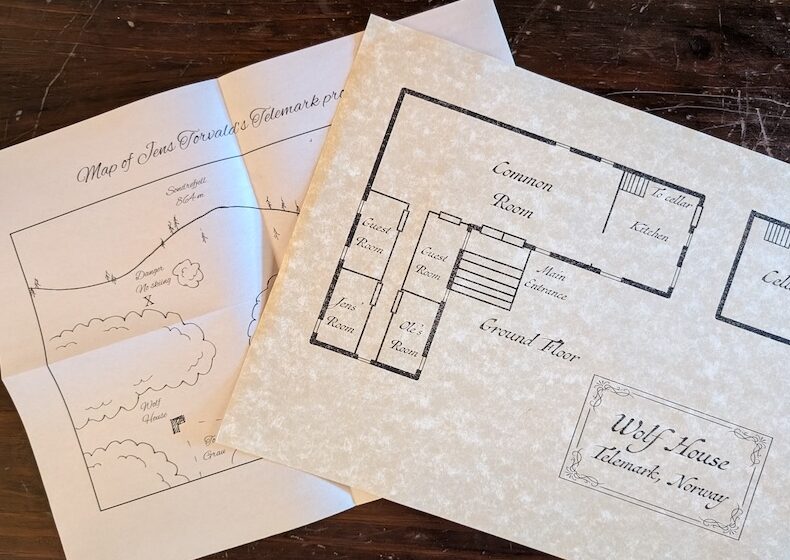
Saturday night, I ran a game of Vaesen entitled Blood on the Slopes, although I think that when I publish it, I’ll change the name to Wolf House. (Yes, Saturday was a long day. A great day, and a long day.) The first is maybe attention-getting for a con game, but the second is, I think, more evocative of the tone of the adventure itself. I’ve written about my love for Vaesen before. To me, it strikes a very fine balance for a horror-themed game: It is simple to learn, with just enough complexity to create the gradually escalating tension that horror storytelling needs, so I can easily onboard people to it. Also, unlike many simpler horror games, it allows for heroic/positive endings as well as dark/horrible endings. So, PG-13 horror? The intended vibe of most of my games is Tim Burton’s Sleepy Hollow, and the rules system supports that very well.

This scenario is especially poignant for me because it evolved from the very first Vaesen scenario I ever wrote and ran, for one of my pandemic-era gaming groups. I have strong tendencies toward complex scenarios (I’m working on it!), and this scenario had to go through many, many drafts (it was a couple of different kinds of murder mystery, a few times) before it reached its current, quite simplified and playable state, without losing the ski racing bit. And this session went really well, IMHO. Skarsden, Caspar, Johan, and Fr. Skellig, that was genuinely one of the most intense role-playing sessions I’ve ever had. Way to collaborate to deliver on the creepy and moody Norwegian fairytale/horror vibe!
The Silliest Expedition
After not quite enough hours of sleep, I was back at it on Sunday with a game of Errant, GM’d by Sean Nittner. In Errant, you play an absolute failure willing to risk their life for a chance at success. (There are actually tables on which you can roll to find out your previous failed career. I played Puliaris, an ice fiend who saw the dawn of the earth, and had also failed as a nanny! That was fun to justify.) At least the way that Sean ran the game, your adventure is created randomly as you go on your expedition, and each player takes on an additional role to help manage that process (lorekeeper, cartographer, caller, etc.).
I have mixed feelings about this game system. On the one hand, my character seemed simpler than a 5e sheet. However, it felt like each character class (playbook?) was fairly different, and so I felt like the whole table had to operate at a nearly-5e level of complexity. That said, this was also all of our first times playing this game, and I didn’t get to flip through the rulebook, so it may be that I’d appreciate its simplicity over time.
I did appreciate the option for the “adventure” to be created randomly over time. I can see that reducing the entry barrier for GMs. I think that that works best if the players can be trusted to engage in the special assignments given to them effectively; I can see a lot of players not wanting to engage with being Quartermaster or Timekeeper, which could hamper fun. At our table, it worked out well. I had a great time being Lorekeeper, turning my notes into Puliaris’ illustrated personal journal of the quest’s events. I also have to commend Sean for his willingness to incorporate player ideas into the story (e.g., Puliaris’ string of ex-boyfriends).

I’m interested in taking a second crack at Errant one of these days. My current read is, it works really well for players open to playing fragile characters in lethal worlds on potentially silly expeditions, and willing to put in a bit of extra work and stay engaged at the table. I wouldn’t try it with power gamers or kids, at least not until I understand it better.
Special Guests Q&A
My last event was the Sunday Special Guests panel discussion, which included Betty Tatum of Free League and Lurking Fears, Connor McGoey of Inside Up Games, Sean K Reynolds of Monte Cook Games, and Seth Hiatt at Mayday Games. This was a great opportunity to talk directly to people working and leading in the game industry and see all of the different approaches to creating (and defining!) success in that space.
Here are a few of my most important takeaways:
- Very few people make a full-time living as a game designer. Most either wear a dozen hats in their company, or have a “regular” day job.
- An easy way to get started in the game industry is to volunteer. Volunteer at a booth, volunteer as a GM, etc. Everyone knows everyone, so word of your abilities will spread pretty quickly.
- Crowd-funding is very different if you’re producing a book than if you’re producing a game. If you’re making a game, backers want to see prototypes and want to know that you’ve tested the game already; so putting in on Table Top Simulator is essential. If you’re making a book, on the other hand, backers are much more willing to back an “idea” with a few art samples and some sample content.
- If your company is funded through crowdfunding, you must carefully manage cash flow. People need to get paid on time, whether you’ve got a new product or not.
Thanks for all of the speakers for their time!