
(In case anyone is wondering, I received no compensation for this post. I just played this game, enjoyed it, and wanted to tell y’all about it!)
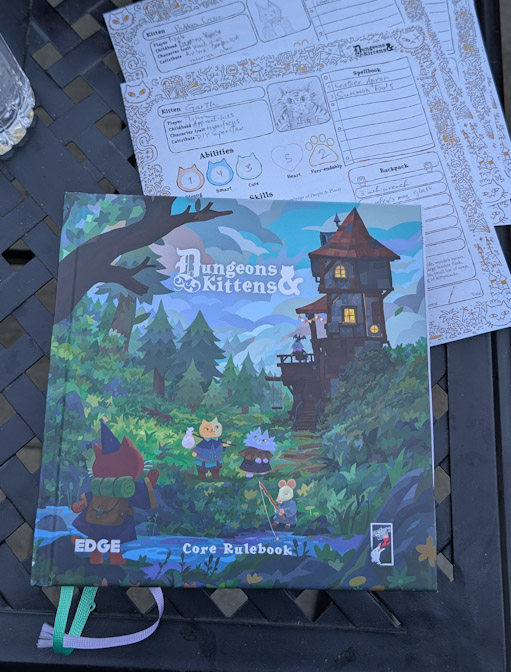
Last weekend, one of the players in my regular 5e Vecna: Eve of Ruin campaign (heavily modded, of course) was missing. Since we’re near the climax of the story, instead of trying to play without him, we decided to switch it up: My nephew “A” ran a one-shot of Dungeons & Kittens from Edge Games. D&K markets itself as easy-to-learn, easy-to-run, and very cozy and cuddly. Here are my thoughts on how well it delivers on that promise.
Promise #1: Easy to Play
D&K really is easy to learn and play. Character creation takes all of 10 minutes, and everything fits on one sheet of paper. Your kitten has three ability scores: Strong, Smart, and Cute (AKA Charisma). When you attempt something, you roll 3d6 (mostly) and compare the dice to your score in the appropriate ability. Each die that is equal to or below your score in that ability is a success. So there’s only one shape of die and very limited math. In addition, you’ve got lots of features like Skills, Cat-tributes, and gear that let you either add dice to your pool or reroll dice. So while it isn’t as simple as, say, Honey Heist, it’s still super easy.
Promise #2: Easy to Run
I didn’t GM this game, so I have to take A’s word for it. But from what I’ve seen, I would say yes, it is easy to run. First, it includes a bunch of starter scenarios in the book to help you get your campaign off of the ground, which A tells me are very good. Second, this is only A’s third or fourth time GMing anything, and I was very impressed by how well he handled our party’s shenanigans (I’d like to think he’s had a good teacher) and managed rules-related questions. So not only do I believe it’s easy to run, but I believe that it’s easy for a kid to run (at least, a 14 year old). If you’re looking for a cozy RPG, that may be a special value proposition to you.
Promise #3: Cozy and Cuddly
Yeah. This… might be the cutest, coziest game I’ve ever played? Just… wow. I actually think that there’s a lot to learn about game design just from this one case study.
First, let’s look at where everyone usually looks for game vibe: The game world. Not surprisingly, D&K gets this right. You all play adorable kittens (unless you happen to play a puppy, or fluffy bird, or weird-but-still-cute catfish, or the like), exiled from your city by the greedy cat overlord Walter for… reasons. You’ve got nothing with you but a bag of purr-ecious items, your meow-gic spells, and your friends (AKA the party). The world is post-apocalyptic, but in the cutest way possible: Humans have gone missing and are mostly forgotten (in legend, they are called Big Bare Butts), and left talking animals in their wake, who wear adorable outfits and behave in adorable ways. So, yeah, it’s a cozy, cuddly world.
The art, by Clément De Ruyter, reinforces this vibe perfectly. Bright colors, soft lines, and happy kittens in adorable outfits stare back at you from every page. Even the drawing of kitty combat is cute.
Okay, but all of this stuff is window dressing. I continue to insist that what really determines a game’s vibe is its rules, and specifically, how well they support the intended vibe, which is technically called “ludo-narrative harmony.” Here, D&K absolutely knocks it out of the park. All of the rules are optimized to reward pro-social, pro-cozy choices, and punish anti-social, anti-cozy choices. You see this in the rest/recovery rules, where PCs recover lost Heart and Furr-eindship points by hanging out and relaxing with their friends. You see this in the lists of skills and meowgic spells, which are all constructive and cozy. You see it in all sorts of little details through the game. But the best example of this (and its impact on ludo-narrative harmony) is in the combat rules.
In D&K, there are two types of “quarrels”: Fang quarrels (verbal arguments) and Claw quarrels (actual physical combat). In D&K, fights start as Fang quarrels, and if an opponent is defeated in the ensuing insult contest, they’re… defeated. They slink off to lick their wounds and maybe learn a valuable lesson, and do not come back later to get revenge. That last bit is actually written into the rules. This isn’t like 5e, where an insulted opponent will run and get a poison dagger and hit you again when you least expect it!
So, first, the game lets you win “combat” without engaging in a physical alteration. Beyond that, however, getting into a Claw quarrel immediately penalizes your character: You lose precious Furr-eindship points, a valuable resource that you can use to automatically succeed on checks or heal damage. That’s on top of whatever damage you take in the fight. So letting a fight escalate to that level is pretty detrimental to your character.
The impact of this combo on the behavior of players is real. I’ve got a 13YO murder-hobo at my table. In 5e, he plays an elf fighter with a big sword who wants to attack anything with legs. In this game, he played a scruffy stray kitten with a knife, and didn’t once try to kill anything! He did look through the smuggers’ tents for anything of value (some habits are too deep to break), but he was perfectly satisfied by D&K’s Fang quarrel “war of words.” I’ve been trying to get him to consider non-violent solutions to problems for a year, and all it took was the D&K rules system!
(Side note, related to my core newsletter topic, RPG mysteries: This is exactly the problem that 5e DMs have with a lot of mystery scenarios. 5e is arguably a combat simulator, and when players are presented with challenges that shouldn’t be solved with combat, the whole game can struggle. It is ludo-narratively… unharmonious. I’ll write an article soon about how to manage that in 5e, but for now: Flavor text and art alone don’t define a genre! Your mechanics have to reward it, too!)
But Is It Fun?
Yes. Unequivocal yes. Obviously, it depends on your gaming table buying into the vibe, etc. At my table, we had a great time. We were objectively silly and laughed a lot, and it was grand. The rules never got in the way of the fun; instead, they supported the story that we thought we were going to tell, and that we did tell. Plus it’s a simple and light enough game that I could see bringing the character sheets and a few key photocopies along on family vacations to play in airports or the like. So, yeah, if you’re looking for a cozy, family-friendly, fun, and easy-to-play TTRPG, I highly recommend Dungeons & Kittens!
Want to see more of the games I’m playing and designing? Want to learn more about how RPG rules design supports storytelling and immersion, especially in mysteries? Subscribe to the Riddle & Rook mailing list and follow me on Instagram, where I show snapshots of the games I’m playing and offer immersive RPG advice!