
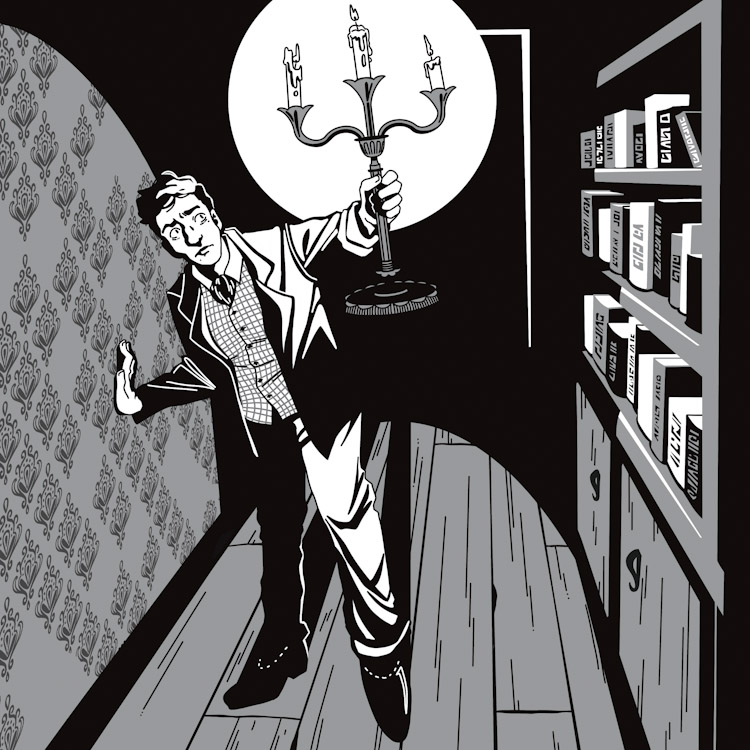
The last few weeks have been busy, between summer vacation and work and life! However, I finally found time this morning to sit down and work more on The Haunting of Dresden Manor. I’ve now completed a first draft of my expanded list of clues, evidence, threats, and spooks (I’m not calling them dangers any more) for each suspect, and I’ve outlined all of the other NPCs. That’s one step closer to a playtest!
I promised in my last Design Diary entry that I’d talk more about how Clues and Evidence will work in the scenario. Since then, I’ve been trying to figure out how to articulate my practices around designing TTRPG mystery scenarios. I’ve been making them for a while, but it’s hard to describe what I’m actually doing. Here’s my first attempt at an explanation about how Clues work.
Rule #1: Create Space for Deduction
When I think about a deductive mystery, I imagine the players combining clues in ways that aren’t explicitly stated, in order to figure out the mystery. If the PCs want to know who killed the mayor, and they immediately find a letter saying, “the baker did it,” then the players don’t have to make any logical connection on their own: the solution is spelled out for them. If, on the other hand, they find a letter from the baker to the mayor, complaining about the new sales tax on grain, they can hypothesize that the baker was angry with the mayor; and then they can test that hypothesis by interviewing the baker (and maybe finding the bloody rolling pin with which he killed the mayor!). That’s deduction. (Technically, it’s induction, but that’s a topic for another day.)
Therefore, I want to ensure that no single clue can carry an investigator all of the way from the beginning of the problem to the solution. Good clues should only carry the investigator part of the way to the solution. That creates the space that players need to develop their own hypotheses.
For example, if the players are searching for a merchant’s hidden treasure, one clue might indicate that the merchant spent a lot of time in his study at the end of his life. The study might be full of artifacts related to his late wife, suggesting to the players to investigate her mausoleum (where the treasure is hidden). The two clues only work together: Without the knowledge that the merchant spent a lot of time in the study, a room full of artifacts related to the late wife isn’t relevant to the mystery. And without the room full of artifacts, the study wouldn’t help the players find the treasure.
How I’m Doing It (Spoiler-free)
In the Haunting of Dresden Manor, there are lots of witnesses. However, none of them are particularly useful in the beginning. Either they don’t know much about what’s going on, or they’re reluctant to say anything… for now. This will create space for the PCs to start exploring and developing their own hypotheses, that the NPCS can eventually support or refute.
Rule #2: Directions Versus Hypotheses
I distinguish between two types of clues: Clues that help players develop or test a hypothesis, and clues that just point players toward another clue. I call these Painters and Pointers.
Painters are clues that give the players evidence to create or support a hypothesis about the mystery. Let’s say that the mystery is, “who stole the holy relic necessary to anoint the new queen?” A Painter clue tells the players something about the solution to the mystery. Maybe there are heavy boot prints around the chapel where the relic was stored, suggesting that the thief wore big, heavy boots. If a witness heard a bit of conversation and noticed an accent, this suggests that the thief was a foreigner. These help paint a picture of the solution.
Pointers, on the other hand, tell the players where to look for another clue. Sticking with our holy relic mystery, one of the witnesses may say, “No one knows more about the relic than Abbot Christoph.” All that sentence does is suggest to the players to go ask Abbot Christoph about the relic; it points them toward the abbot. The same is true of a scrap of paper found in the woods outside the chapel that says, “Once you get the treasure, meet me at the docks.” This points the players towards the docks.
It’s possible for a clue to be both a Painter and a Pointer at the same time. For example, Abbot Christoph can mention, “When the duke came in to inspect the relic last night, he acted quite strangely.” That both suggests that the duke knows something about the theft (Did he do it? Does he know who did?) and encourages the players to seek out the duke (Where is the duke now? Who can tell them that?).
One easy way to create the space necessary for players to develop a hypothesis is by linking Painters and Pointers. Once the PCs follow that note to the docks, they may notice that most of the sailors are barefoot… except the diplomat who is about to set sail, who is wearing heavy (and muddy!) boots. Now they have someone to investigate. Or, when the PCs talk to Abbot Christoph, he can tell them that, in the absence of the relic, ancient tradition holds that the duke will instead be anointed the ruler. Now the players have a possible motive for the theft.
How I’m Doing It (Spoiler-free)
In The Haunting of Dresden Manor, depending on who is the Villain, the PCs will experience different phenomena as they explore the manor. These phenomena are designed to suggest a culprit (Painters). Meanwhile, servants or other clues can direct the PCs to specific locations to explain those phenomena (Pointers).
Keep It Simple, Savant
Based on that advice, it’s tempting to try to create intricate mysteries with long chains of Painters and Pointers. For a novel, that’s okay, because your characters can remind themselves of all of the evidence whenever you want. But for a TTRPG scenario, I believe that it’s critical to keep your clue sequence fairly short.
The main reason for this has to do with your players’ memories. TTRPGs are a weird storytelling format. Not only are they collaborative and improvisational, but also the storytelling is often broken up into three- to four-hour sessions, with a full week or two in between them. Every DM wishes that their players would remember every little bit of lore in between sessions, but realistically, that’s asking a lot from everyone. So even though I want to give players space to actually deduce the mystery themselves, I also want to keep that space relatively small, so that they don’t forget the early clues.
To support that, in most of my mysteries, I keep my sequences of linked clues, or clue chains, relatively short. For example, if I’m going to leave a bootprint at the crime scene, I don’t want to save the discovery of the incriminating boot until the very last scene. If I did that, there’s a good chance my players would forget about the bootprint clue and never make the connection! Instead, I want the players to find someone in boots relatively quickly; so I soon present them with a pointer clue that will take them to that person in boots.
This doesn’t mean that the mystery should be simple. That person in boots can then lead them to another clue. For example, the diplomat at the docks might have a letter in his pocket from a person who signed as “N” offering him a bag of golden ducats in exchange for stealing the relic. Now the players know who stole the relic (the diplomat); but they still don’t have it, and they don’t know who N is (she always wore a mask when she met the diplomat), and they don’t know why N wanted the relic. What’s important is that the early Painter clue (the bootprint) has now served its purpose, and the players are focused on a new part of the mystery.
How I’m Doing It (Spoiler-free)
The Haunting of Dresden Manor is not intended to be a long mystery. I believe that it can reasonably be completed in one four-hour play session. That simplifies my mystery design. However, I’m still applying this principle. Early in the mystery, the players will observe phenomena (Painters) that suggest to them who or what the villain is. They’ll also receive Pointers that direct them to locations or witnesses to help them test those hypotheses. But once they have a clear hypothesis, that’s only the beginning. They will still have to figure out what that villain is actually doing; and then how to stop it!
Wrap Up
I’ve got a few more things to say about clues and working memory in TTRPG mystery scenarios. In a future post, I’ll talk about how I use physical props to support player memory, and how I’m planning to distinguish Evidence from Clues to support DM working memory. I’ll also talk about red herrings, and how to deal with players going off track. But that’s enough for now.
However, before I go, I want to share one image with you: The draft floorplan of Dresden Manor!
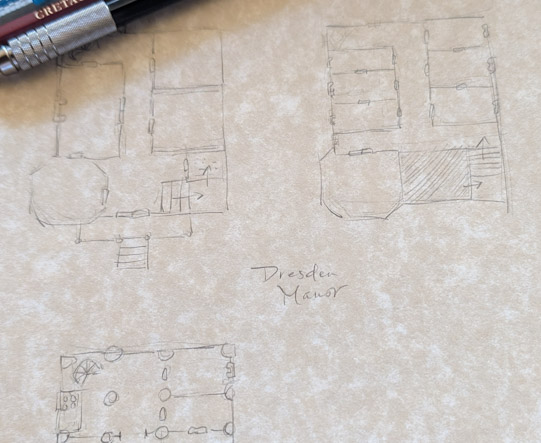
My first few playtests of this scenario were entirely theater of the mind. I described the room, players constructed models of the space in their heads, and all combat was conducted with post-its on the table representing the different zones in that space. However, since my next step is to write up the location descriptions for each room in the house, I figured that a physical map would help me do that more thoughtfully.
Finally: I expect to begin playtests in September and October, building up to my ultimate goal of taking The Haunting of Dresden Manor to Kickstarter to fund professional layout and more art. If you want to be one of my playtesters, I’ll announce it first on the Riddle & Rook newsletter, and then on Instagram. Follow those to get first dibs on seats at the table!