
TLDR
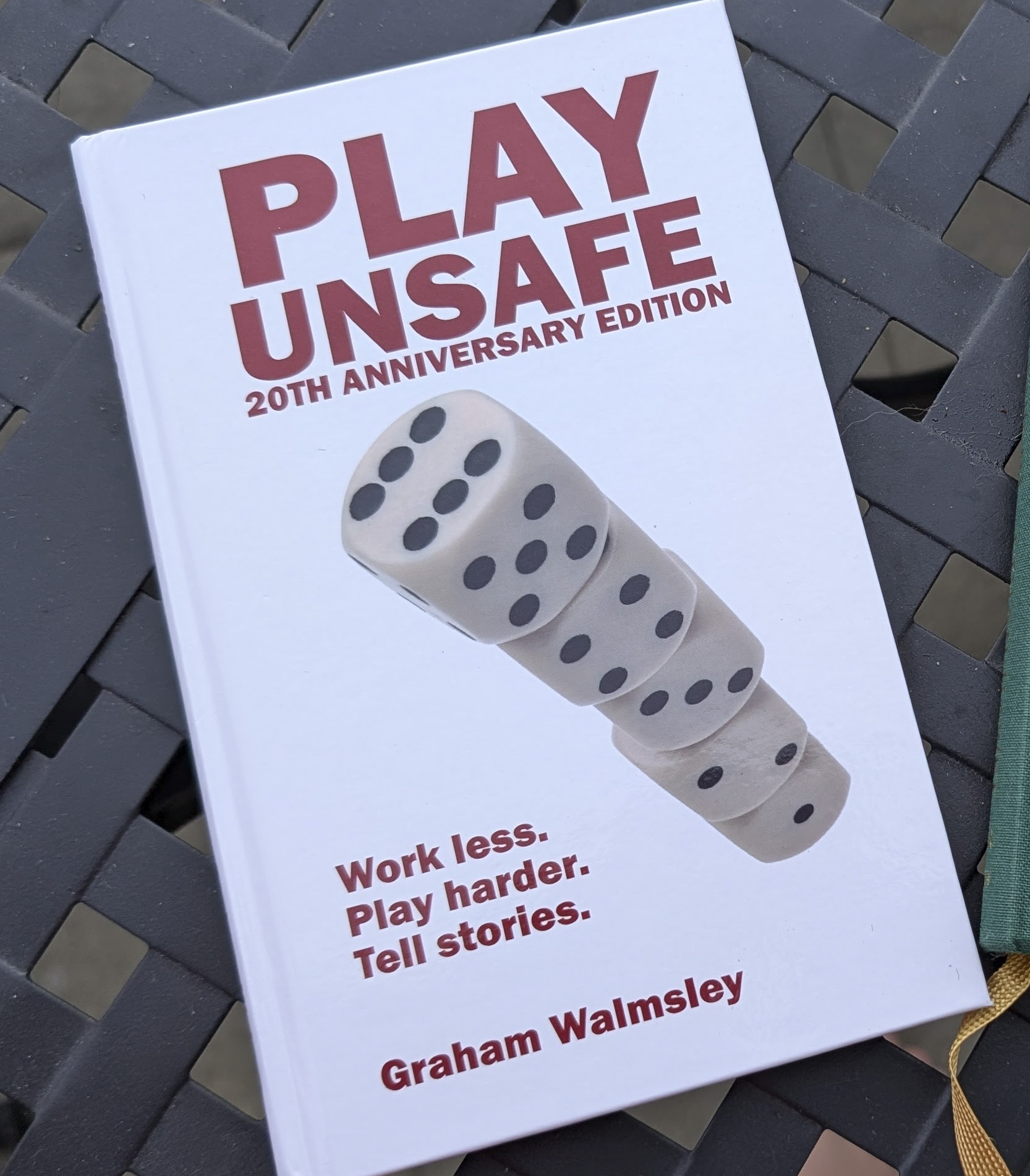
My TLDR review: Play Unsafe is a very good book about becoming a better role-player. It’s a super quick read, less than an hour total. If you’re a player, definitely read it. If you’re a DM, it will be really helpful if you’ve got a bit of experience already. If you’re a novice DM, though, maybe start with Return of the Lazy Dungeon Master by Sly Flourish, and then move on to this.
Long Read
Want more detail? Here you go: Two weeks ago, I took the time to read Play Unsafe: 20th Anniversary Edition, by Graham Walmsley. I backed the Kickstarter for the book’s reprint at the recommendation of my friend (and founding TavCon GM!) Charles Picard. (At some point, I’ll write a bit about how I now understand Kickstarter as a storefront for certain brands. But that’s another topic) It is a super-quick read. It’s 85 pages, but they’re… like, quarter size pages? So it’s really more like 22 pages. It’s basically the length of one of the old TSR D&D modules. Its advice is divided into five thematic sections: Play, Build, Status, Tell Stories, and Work Together, and you probably should read them in order, as each builds on the last.
But how’s the content? It’s great, genuinely great, if you want to up the role-playing component of your games. What impresses me most is that it is at least as useful for players as for DMs. The overall summary of the book is, as with improv: Plan less, listen more. Walmsley interleaves the advice with simple and useful examples of how he has applied each principle, which helps make it easier for a player to understand.
If I have a hot take, it’s that this book is actually more useful for players than for DMs. It’s really easy for a player to try out this advice; what do you have to lose? If I was a brand-new DM (which I more or less was, when I was getting back into games in 2020 and 2021), I would have struggled to take the risks advised in this book. Now, after a ton of DMing and two years of improv, I’m like, “This is the Way.” But if you’re a DM who still struggles without hours of prep and sheaves of notes, I’d recommend instead that you start with Sly Flourish’s Return of the Lazy Dungeon Master. It is also a quick read that gets right to the point, with more or less the same general perspective, but it is less theoretical and more practical, with a lot more DM-specific scaffolding.
(Sly is currently running a Kickstarter for an expansion of that book called Rise of the Lazy Game Master. I have no connection to said Kickstarter, and honestly, I have trouble imagining how anything could improve on Return of the LDM. In fact, I feel like any additional content would make it worse, not better. But as an aspiring entrepreneur in the gaming space, I feel like it’s… good luck to mention it? So, here’s to hoping that a bit of Sly’s fortune rubs off on me and my first Kickstarter, planned for this February! Want to learn more? Sign up for my mailing list and I’ll definitely tell you about it! A lot!)
Okay, so what kind of advice does this book actually give? Here are a few of my favorite pieces of advice:
Tip 1: Don’t Plan Ahead/Hold Ideas Lightly
Early in the book, in the Build section, Walmsley introduces two related ideas: “Don’t plan ahead” and “Hold ideas lightly.” The first idea seems counter-intuitive to many DMs: If I don’t plan ahead, how will I know what to do? But it’s actually very good advice, because you never know quite what your players will do. The more you plan ahead, the more brittle your scenarios, and the more likely that something will go wrong with your planning. And that means more improv work, namely, the same improv work that you would have to do anyway if you just didn’t plan.
And that brings us to the second half of the concept: “Hold ideas lightly.” I don’t know about you, but I have great ideas. My ideas are dramatic, funny, mysterious, interconnected, and all of the other adjectives that I can imagine a good game should have. But if I insist on holding onto my ideas when my players make diverging choices, I create two problems. First, I make a lot more work for myself, because now I not only need to improv, but I need to use improv to twist everything back around to my original idea. Second, and probably more important, I’m also ignoring my players’ choices, which means I’m ignoring their ideas for how the story should go. If games are collaborative, then I have to collaborate, too.
Instead, if you’re a DM, plan loosely. Have a few ideas, maybe some factions and stat blocks, and some idea of what each one faction plans to do. Then, let your players bounce around in your scenario like pinballs to see what happens. Finally, at the end of the play session, spend 5 minutes thinking about how your players’ actions in the session would change what each faction wants, and use that to “plan” the beginning of the next play session.
How I apply it
As I said before, I’m a recovering planaholic. When I got back into RPGs at the beginning of the Covid 19 pandemic, I’d write pages of notes about plot arcs, motives, lore, secrets, plot twists, etc. This is probably what ended my first campaign, which was just for my kids. They had just finished a plot arc where they became adopted royalty in the City of Brass, and they wanted to continue living like princes(ses) in their interdimensional villa. I could have easily kept inventing adventures in the Inner Planes, but I was really attached to a plot arc that went back to our very first adventure, involving a baby gold dragon, back home in the Forgotten Realms. Well, when I pushed the adventure back to the Realms, my kids got bored with that story, and ultimately decided that they wanted to start a new campaign with new characters (which we did, and where I tried to be less control-y, with some notable success).
During the pandemic, I also ran a 5e Rime of the Frostmaiden (my favorite 5e module and maybe favorite-ever D&D book) campaign for some adult friends, for which I also did a ton of planning. However, around this point in time, I discovered Return of the Lazy DM, and decided to try implementing its advice to plan less and listen more. Specifically, towards the end of the official campaign as-written, I tried simplifying my story down to three factions, each with their own motivations; and planning exactly one session ahead. Not only did this dramatically reduce my prep time for each session, but my players had just as much fun, too.
So if you’re a GM, I consider this to be excellent advice. I can’t say that I’ve been a player in a long-enough campaign to vouch for it as player advice, too, but if I get that chance, I’ll definitely give it a try.
Tip 2: Take Status, Then Change
Walmsley introduces five different types of status. From an RP perspective, I’m most interested in two (three?). First, Given status is your character’s in-game social status. (It seems very similar to Walmsley’s Character status. If someone wants to explain the finer differences between them to me, send me an email at john@riddleandrook.com. Or join my mailing list and I’ll email you, and then you can just reply to me!) A duke usually has a higher Given status than a peasant, and an archmage has a higher Given status than an apprentice wizard. Okay, easy enough.
Behavior status is how you play that character. Do you play your character with good manners (high status, maybe) or bad manners (low status)? Tough (high status) or passive (low status)? Educated (high status) or illiterate (low status)? (To be clear, what qualifies as high or low status depends on the game. We can imagine a story in which good manners are a sign of weakness, and being illiterate is a sign of strength.)
Combining Given and Behavior status in unexpected ways is an easy way to create interesting, memorable characters. Imagine a rude (low behavior status) knight (high given status) next to his brave (high behavior status) squire (low given status). What about a silly (low behavior status) dragon (high given status)?
This technique gets really powerful, though, when you create opportunities to change your status, especially in relationship to other characters or factions. Imagine a proud character becoming humbled; or a poor character becoming rich and powerful. What if that brave squire received the award while the rude knight sat on the sidelines? What if the silly dragon chose the brave squire as his rider, not the knight? These are the seeds of great stories.
The easiest way to start applying this technique is to just tell your fellow players that you want to try it. Say something like, “I like this NPC. I am interested in my character Sir Charles getting a little bit of his comeuppance here. Can we do that scene?” Or, “I’m really interested in pursuing the Lost Mine of Garathax. How would you feel about my normally quiet character demanding information rather than gold from the duke? Would you work with me to work that into the story?” Your GM and fellow players will almost always say yes, and pretty soon, this will become second-nature to you, and then maybe they’ll start doing it, too!
How I apply it
One of the exercises that my totally amazing improv teacher, Laura from Zipline Improv, used to have us do was invent and play low and high status characters. I started with a tendency to choose high status characters, but after I tried my first low status character, I realized how much fun it can be. When I played a high status character, I started from a position of fear: I felt a need to preserve my status. As a low status character, though, I started with nothing to lose, which gave me many more interesting options: I could stay low status, or I could become high status! (With practice, I eventually learned to also enjoy losing high status, too, but it did not come quickly.)
Now, when I get to be a player in a game, I mostly make low-status characters. I often play tricksters and con artists, low-status characters who seize high-status over others through their schemes. I especially love creating characters bound or connected in some low-status way to a high-status NPC, because of the story opportunities it creates. Am I a paladin tied to a holy order that gives me orders with which I don’t always agree? Am I a thief being pursued by a crime boss whom I cheated? There’s so much great role-playing material in those seeds!
At TavCon, in DM Sawyer’s game of Monster of the Week, for example, I played Guillaume, an old occultist who had been given a crap assignment by his secret order (low given status), but was still ruthlessly devoted to killing monsters (high behavior status). When the GM finally gave Guillaume his assignment, it included instructions from his order to save one of the werewolf’s victims “for research.” I enjoyed role-playing how much following this order this frustrated Guillaume; and when a terrible roll later on gave me an opportunity to describe a bad outcome for my order, I really had fun describing a news report that the ambulance with the victim had been found by the side of the road, crashed and empty! If I hadn’t emphasized his low status early on, that “I told you so” moment when Guillaume gained high status wouldn’t have been nearly as powerful. (Plus, it turned into our characters’ next mission!)
This technique can also help you learn to role-play with the other players at your table. Laura taught me that, in improv scenes, you’re looking for a reason for your character to change. Status reversals are an easy way to practice this. In a Vaesen con game, I played a sanctimonious (high behavior status) Servant (low given status) who disliked and judged the party’s woo-woo (low behavior status) occultist (low given status). Our characters’ early friction was fun to role-play, but what was even more rewarding was letting my character’s opinion of the occultist evolve during the play session. With that player’s permission, I role-played surprise at her character’s successes, which gradually turned into respect. By the end of the game, it felt perfectly natural for our characters to have become friends. It was a memorable story for me.
Conclusion
So, in summary, Play Unsafe is a really good book for players. It’s short and easy to read, which means that your players are way more likely to read it than, say, their own spell lists. If you’re an experienced GM, you’ll at least enjoy it, and you may also get a lot of value from it. However, if you’re a relatively new DM, I encourage you to also look at Return of the Lazy Dungeon Master. I think of Return of the LDM as levels 1-10, and this as levels 7-12, if you don’t mind a 5e metaphor.
Got a different opinion? Want to talk more about games, gaming, and game design? Send me an email! Or join my mailing list, and I’ll send you an email! (Ooooh, status change!) Or follow me on Instagram! Or… no, that’s actually about it. For now…