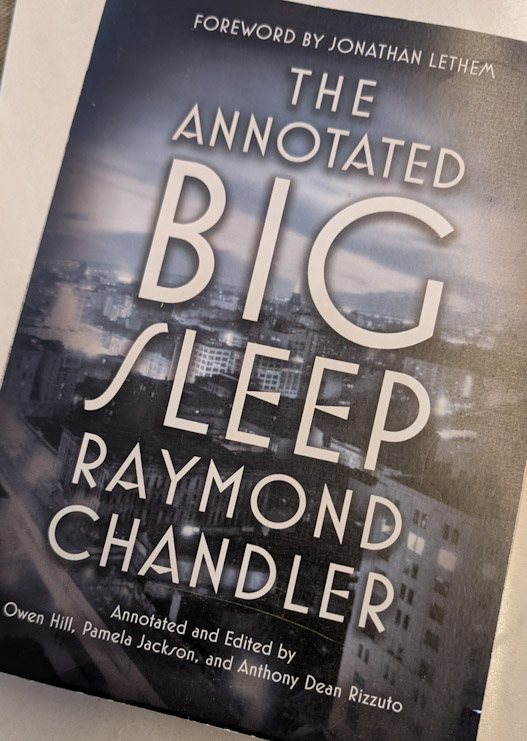
To help get me in the mindset for my new project, a mystery scenario called The Haunting the Dresden Manor, I spent a few days this month with one of the masters of the genre: Raymond Chandler, and specifically The Annotated Big Sleep, edited by Owen Hill, Pamela Jackson, and my esteemed colleague Anthony Rizzuto. Chandler has a lot to teach DMs about designing fun, immersive mystery adventures. Here are my two biggest takeaways for running memorable, fun mysteries:
Mystery Tip #1: Set the Tone with the Location
Part of what makes The Big Sleep so compelling is Chandler’s gritty Los Angeles; and Chandler has a powerful gift for bringing it to life. For example, look at how he describes Marlowe’s midnight walk from the General’s house in Chapter 8:
Ten blocks of that, winding down curved rain-swept streets, under the steady drip of trees, past lighted windows in big houses in ghostly enormous grounds, vague clusters of eaves and gables and lighted windows high on the hillside, remote and inaccessible, like witch houses in a forest.
You can practically feel the wetness, but more importantly, you can also feel Marlowe’s sense of isolation from the distant, barely visible, even threatening (“like witch houses in a forest”) world around him. Or, look at his description of Eddie Mars’ Cypress Club in chapter 21:
I got down there about nine, under a hard high October moon that lost itself in the top layers of a beach fog. The Cypress Club was at the far end of town, a rambling frame mansion that had once been the summer residence of a rich man named De Cazens, and later had been a hotel. It was now a big dark outwardly shabby place with a thick grove of wind-twisted Monterey cypresses, which gave it its name. It had enormous scrolled porches, turrets all over the place, stained-glass trims around the big windows, big empty stables at the back, a general air of nostalgic decay. Eddie Mars had left the outside much as he had found it, instead of making it over to look like an MGM set.
Again, you can practically taste the faded opulence of the Cypress Club, once grand, now seemingly overrun with fog and wild trees and the ravages of time.
Here’s why this matters when you’re DMing in general, and especially a mystery: Good mysteries are as much about the vibe as they are about the actual mystery. Are they hard-boiled or cozy? Are they dark or funny? By establishing a strong vibe early on for any given location, you help set and maintain the vibe that you want in your story.
How I Do It
When I’m drafting a mystery scenario, I know that my best opportunity to establish a shared, immersive sense of an environment is the first time that my players arrive in it. Once that is established, I can “reactivate” that feeling later on by just mentioning or referencing one of the elements from that foundation. So I ask myself the following questions:
- What do I see, hear, smell, taste, and feel in my mind when I envision this place? These are my nouns.
- How do I want players to feel emotionally while they are in this scene? These are my adjectives.
For example, in The Haunting of Dresden Manor, I want my players to feel that the Dresden family is wealthy and fashionable; but that beneath that fresh coat of paint, Dresden Manor is hiding dark, old secrets. So my introduction might emphasize:
- That the house has a brand-new, stylish facade (money and style), but its layout suggests an older construction date; and the exposed stone foundation suggests an even more ancient history (“ancient” is an especially evocative adjective for RPGs.)
- The staff who meet you at the door are polite and well-dressed, but glance nervously up the stairs or down the dark hallways as they escort you to the master’s study. (This is a rich household, but the staff know that something is wrong.)
- The furniture in the study is of the latest fashion, but the built-in wooden shelves are dark with age, and the dust-covered books that line them have weathered bindings. (This suggests that the book collection predates the current occupants of the house.)
Once I’ve established this foundation, not only am I giving my players leads to investigate, but I can also conjure up these same vibes later with a single reference to any one of those aspects. If a room has ancient brickwork, or a servant wrings their hand when asked a hard question, or a dark doorway beckons, I’m reactivating these feelings and helping my players stay immersed. Without that foundation, on the other hand, these references will feel superfluous, and perhaps even break immersion in the mystery.
Mystery Tip #2: Make Your Characters Distinct
Chandler’s characters are all incredibly distinct, not just in their visual appearance, but in how they make you feel about them. For example, here is Marlowe’s first impression of Eddie Mars at the beginning of chapter 13:
He was a gray man, all gray, except for his polished black shoes and two scarlet diamonds in his gray stain tie that looked like the diamonds on roulette layouts. His shirt was gray and his double-breasted suit of soft, beautifully cut flannel. Seeing Carmen he took a gray hat off and and his hair underneath it was gray and as fine as if it had been sifted through gauze. His thick gray eyebrows had that indefinably sporty look. He had a long chin, a nose with a hook to it, thoughtful gray eyes that had a slanted look because the fold of skin over his upper lid came down over the corner of the lid itself.
Now compare that to his introduction of Harry Jones in chapter 25:
He slid past me carefully as I held the door, as carefully as though he feared I might plant a kick in his minute buttocks. We sat down and faced each other across the desk. He was a very small man, not more than five feet three and would hardly weigh as much as a butcher’s thumb. He had tight brilliant eyes that wanted to look hard, and looked as hard as oysters on the half shell. He wore a double-breasted dark gray suit that was too wide in the shoulders and had too much lapel. Over this, open, an Irish tweed coat with some badly worn spots. A lot of foulard tie bulged out and was rainspotted above his crossed lapels.
Both of these characters are distinct and memorable. Eddie Mars is a wave of rich, comfortable, silver energy rolling over you. You feel his wealth, you feel his confidence, you feel his analytical mind. Harry, on the other hand, feels like a kid playing at being a criminal: Chandler emphasizes his small stature, his shabby and mismatched clothes, and his wannabe-tough eyes. You get why Marlowe respects Mars, and why he takes a liking to Jones; and as the reader, you do, too.
Here’s why this matters in a mystery: Your players are likely to meet a lot of characters, many of them suspects, and since we often split up a story over multiple play sessions with a week or longer in between, you need to make the NPCS who are critical to the mystery as distinct and memorable as possible. Otherwise, when it comes time to put the clues together, your players will struggle to remember those NPCs and what they said or did, and the mystery will not only be harder to solve, but harder to enjoy.
How I Do It
When I design NPCs for my mysteries, in addition to the character’s role in the mystery, I apply two principles:
- Unless the resemblance of two NPCs is an important plot element, I make every NPC distinct. I plan for only one hulking tough, only one wiry or nervous character, etc. Then, I pick two or three different features or attributes that you can use to reinforce that idea. Is this NPC an experienced killer? Could she have taught muscles, cold eyes, and the scars of multiple battles on her skin?
- I avoid NPC names that start with the same sound. Only one of my NPCs in any given mystery will have a name that starts with “B,” only one will have a name that starts with either hard “C” or “K,” only one will have a name that starts with “E,” etc.
These two principles help keep my NPCs distinct in my players’ minds as they work through the mystery. They can take notes more easily, and they can more easily identify the NPC two real weeks later when a witness says, “All I remember is the masked figure’s cold, dead stare, like killing the duke had meant nothing to them.” Plus, when they’re discussing clues, it’s a lot easier to keep Carmen and Marlowe distinct in their minds than Carmen and Christian!
Again, this only applies to significant NPCs. You’ll often have to create NPCs on the fly as your players take the story in directions you don’t expect, and these NPCs can be more generic, because distinguishing them later on won’t be as important.
Also, sometimes everyone in an environment will share certain characteristics. For example, all of the soldiers in a battle-hardened unit will probably be strong and scarred. If the various soldiers are all suspects or otherwise important to my mystery, I will find other ways to distinguish them: One might be taciturn and always sharpening a weapon, while another is cheerful and sings songs around the campfire. There are lots of ways to make NPCs distinct.
Conclusion
Besides the game angle, The Big Sleep is a great read. I enjoyed the mystery, Chandler’s writing style, and his tour through historic LA and my own memories: I lived for a few years in Laurel Canyon, the location of Geiger’s mysterious house, and I grew up around Redondo Beach, which the annotators argue is the inspiration for Chandler’s fictional Las Olindas. So if you’re looking for a hard-boiled detective romp, I highly recommended it. If all you want is to immerse yourself in Chandler’s rain-soaked urban sprawl, maybe skip the annotated edition; having the annotations on each facing page is a little distracting from the narrative. For me, though, the annotations helped me appreciate the novel the way Chandler’s contemporary readers would have, which is a different form of immersion!
I hope that these tips help you create more immersive and fun mystery scenarios for your games. I’m certainly keeping them in mind as I draft my playtest copy for The Haunting of Dresden Manor. In the meantime, remember: If you’re looking for inspiration, there are worse places to look than the masters!
Curious about The Haunting of Dresden Manor? Want to see how I apply these principles to mystery design? Subscribe to the Riddle & Rook newsletter, if you aren’t on it already, and follow us on Instagram, where I’ll share snapshots of work-in-progress!